Jamón Ibérico: The Soul of Spain Explained by a Local Expert
Discover why Jamón Ibérico is Spain's greatest culinary treasure — from the ancient dehesa ecosystem to the years-long curing process, explained by a local Seville guide.

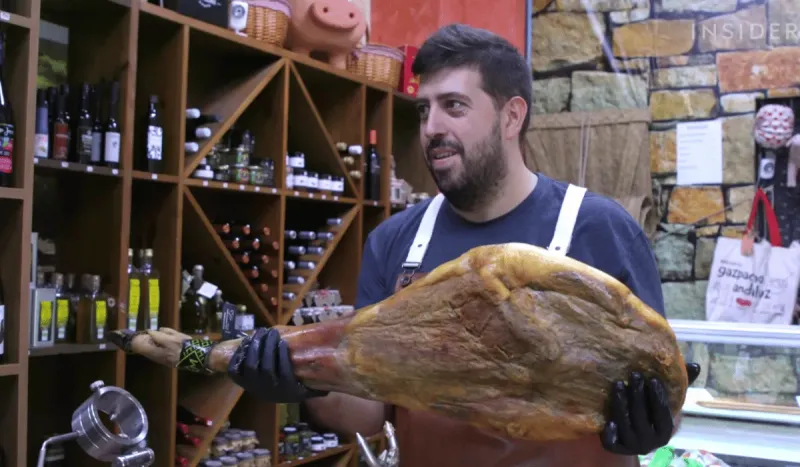
For my entire life, here in the heart of Seville, the sight of a majestic leg of Jamón Ibérico has been a constant. You see it in every bar, every market, every family gathering. It’s as much a part of our landscape as the Giralda tower itself. And while the world is slowly discovering it — and its prices, sometimes upwards of $4,500 — to focus on the price is to miss the poetry entirely.
Jamón Ibérico is not just cured ham. It is a pillar of Spanish gastronomic and cultural heritage. Let me take you on a journey from the ancient oak forests of the dehesa to the silent, hallowed halls of the traditional curing cellars.
More Than a Delicacy, a Cultural Symbol
Jamón Ibérico is central to Spanish identity. In my family, we say that each slice contains a memory of the sun, the earth, and the wind. It’s present at every celebration, every important meal, every moment of joy shared with the people we love.
Historical Roots: From Ancient Rome to the New World
An Ancestral Legacy
The Iberian pig is a direct descendant of the wild boar, Sus scrofa mediterraneus. Its pedigree is ancient. As far back as 77 AD, the Roman writer and naturalist Pliny the Elder praised the superior quality of its meat in his writings. For over two thousand years, this delicacy has been appreciated, establishing a profound antiquity that you can taste in every single bite.
A Transatlantic Treasure
Christopher Columbus himself included Iberian pigs on his ships during his second voyage to the Americas in 1493. Its cured meat, able to withstand long journeys without spoiling, became a strategic provision for oceanic voyages. This demonstrates the product’s value as a durable, nutrient-rich food capable of sustaining the most demanding expeditions in history.
The Sacred Ecosystem: The Dehesa and the Iberian Pig
The Pure Breed: The Iberian Black Pig
What makes the Iberian pig unique is its remarkable ability to infiltrate fat into its muscle fibers. This creates the characteristic veining, or marbling, that makes the meat so tender and flavorful. One of the rarest variants is the “Manchado de Jabugo,” a line with distinctive black spots on its skin found only in the mountains of Huelva.
The Dehesa: A Paradise of Oak Trees
The dehesa is a landscape of rolling pastures dotted with holm oaks (encinas) and cork oaks (alcornoques). Here, the pigs live in complete freedom. By regulation, no more than two pigs per hectare are permitted, ensuring each animal has ample space and natural resources.
During the autumn fattening season, known as the montanera, a single pig can eat up to 10 kilograms of acorns per day. These acorns are rich in oleic acid, the same healthy fat found in olive oil, which fundamentally defines the flavor profile and silky quality of the ham’s fat.
A Seal of Excellence and Origin
The ham is protected by the European Union’s Protected Denomination of Origin (D.O.P.) seal, which certifies that the entire process, from breeding to curing, occurs within a specific geographical area. The main production regions are Salamanca, Huelva, Córdoba, Cáceres, and Badajoz, further divided into four distinct D.O.P.s.
Only a mere 6% of all Ibérico ham production earns the prestigious Black Label distinction, certifying a 100% purebred Iberian pig that has lived freely in the dehesa and fattened on acorns.
The Art of Curing: A Legacy of Patience and Tradition
The Detailed Process, Step by Step
Stage 1 — Salting (Salazón): Immediately after butchering, the legs (jamones from the rear, paletas from the front) are buried completely in sea salt. They remain there for 15 to 20 days, depending on weight. The salt draws out moisture, acting as a natural preservative and beginning the transformation.
Stage 2 — Resting (Asentamiento): After the salt is washed off, the legs spend about two months in a temperature and humidity-controlled room. This allows the salt to penetrate evenly throughout the meat, ensuring a uniform cure before the long drying stages.
Stage 3 — Drying (Secado): Next, the hams are moved to a natural drying shed, or secadero. Here, for six to nine months, they hang in circulating air, often from windows opened to catch the mountain breezes. During this stage, they begin to “sweat,” rendering their fat and developing the foundational aromas and flavors.
Stage 4 — Maturing in the Cellar (Maduración en Bodega): The final and longest stage takes place in subterranean cellars, or bodegas. In this cool, dark environment, the ham matures slowly. On average, this takes a couple of years, but the most exceptional pieces can cure for four, five, or even more years, reaching their absolute peak of flavor and texture.
The Sensory Experience: Carving, Character, and Tasting
The Ritual of the Carve
Carving Jamón Ibérico is an art form, a skill practiced and perfected by a maestro cortador. Using a long, flexible knife, the goal is to produce thin, almost translucent slices. This maximizes the surface area, allowing the aromas to be released and the flavors to bloom on the palate.
Elio’s Tip: When you are served a plate of hand-carved jamón, notice how the fat glistens at room temperature. This is the sign of high-quality, acorn-fed ham. The fat is so low in melting point that the warmth of your hand, or your mouth, is enough to dissolve it.
Analysis of Flavor and Texture
Flavor: Contrary to what you might expect from a salt-cured product, it is not overwhelmingly salty. It is savory and profound, with clear, persistent nutty notes that trace directly back to the pig’s acorn diet.
Fat: The fat is the treasure. It is brilliant, unctuous, and has a buttery texture that melts on the tongue. This fat is the carrier of the ham’s most delicate aromas and flavors. It is where the essence of the dehesa is stored.
Texture: The meat is exceptionally tender. The marbling of infiltrated fat creates a structure that causes each bite to practically dissolve in your mouth, releasing a cascade of complex nuances.
The Legacy of Jamón Ibérico
The high price of Jamón Ibérico is a direct consequence of its extraordinary legacy: the exclusivity of an ancient, sometimes incredibly rare, breed; the sustainability of a protected ecosystem that demands low-density farming; and above all, time. We measure this time not in hours or days, but in the years of patient craftsmanship required to perfect each leg.
More than a luxury food, Jamón Ibérico is the expression of a territory, a celebration of time, and, in its essence, an undying emblem of Spain’s natural and gastronomic heritage.